
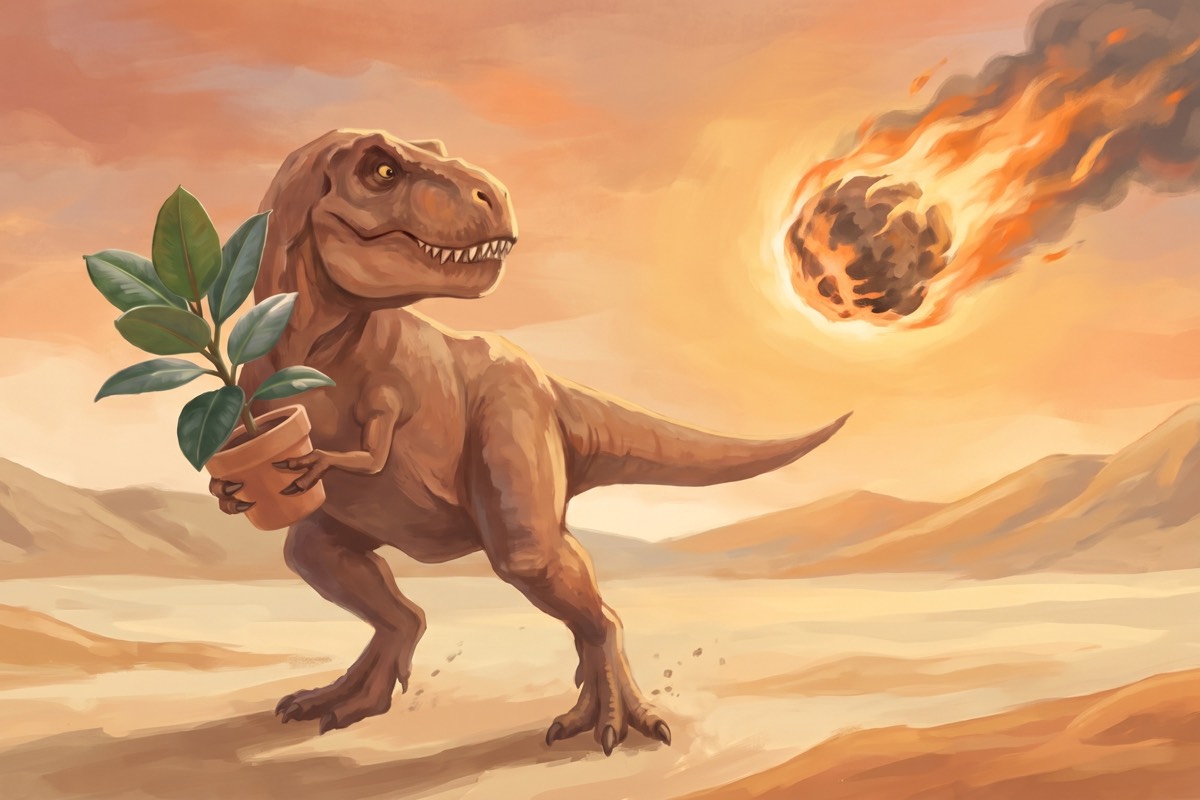
What plant would survive a meteor like the one that killed the dinosaurs?
Ferns. After an impact like that, fern spores fill the fossil record before other plants return. No houseplant is a shelter. The plants that last can wait in the dark: spores, seeds, and food stored underground.
Set a reminder for each plant instead of guessing. Free on iOS and Android.
What the impact did to plants
About 66 million years ago an asteroid roughly 10 kilometers wide hit near what is now the Yucatán Peninsula. People often call it a meteor. The crater is Chicxulub. Non-avian dinosaurs died, and so did most other species on Earth.
Plants did not all die. Forests burned near the impact. Soot and dust then blocked useful sunlight for months. That dark, cold stretch is the impact winter. A leaf that must make food every day starves when the sky stays dim.
How long the dark lasted is still debated. Months without useful photosynthesis is the careful claim. Some models stay cold for longer. The exact number of days does not change the rule: a plant that cannot pause is in trouble.
The rocks do not name one winning species. They show a pattern. Plants that could wait, then sprout on bare ground, came back first.
Why ferns show up first
Just above the boundary layer, at many sites around the world, fern spores suddenly dominate the count of pollen and spores. Paleobotanists call this the fern spike. Flowering plants and conifers return after it.
A fern spore is smaller than dust, so wind carries it far. Many ferns also regrow from a rhizome, an underground stem, after the fronds burn or freeze. The living top dies. The store below can send up a new frond.
That is not “every other plant died.” Seed plants survived too. They came back more slowly, often from seeds already in the soil. Ferns simply arrived first. At some sites the spike lasts a long stretch of the earliest time after the impact, not a single season.
A Boston fern on a shelf is not a Cretaceous species. It uses the same two tricks: spores, and a crown or rhizome that replaces lost fronds. Dry apartment air can still kill it. The trait helps with darkness and damage. It does not make the plant neglect-proof.
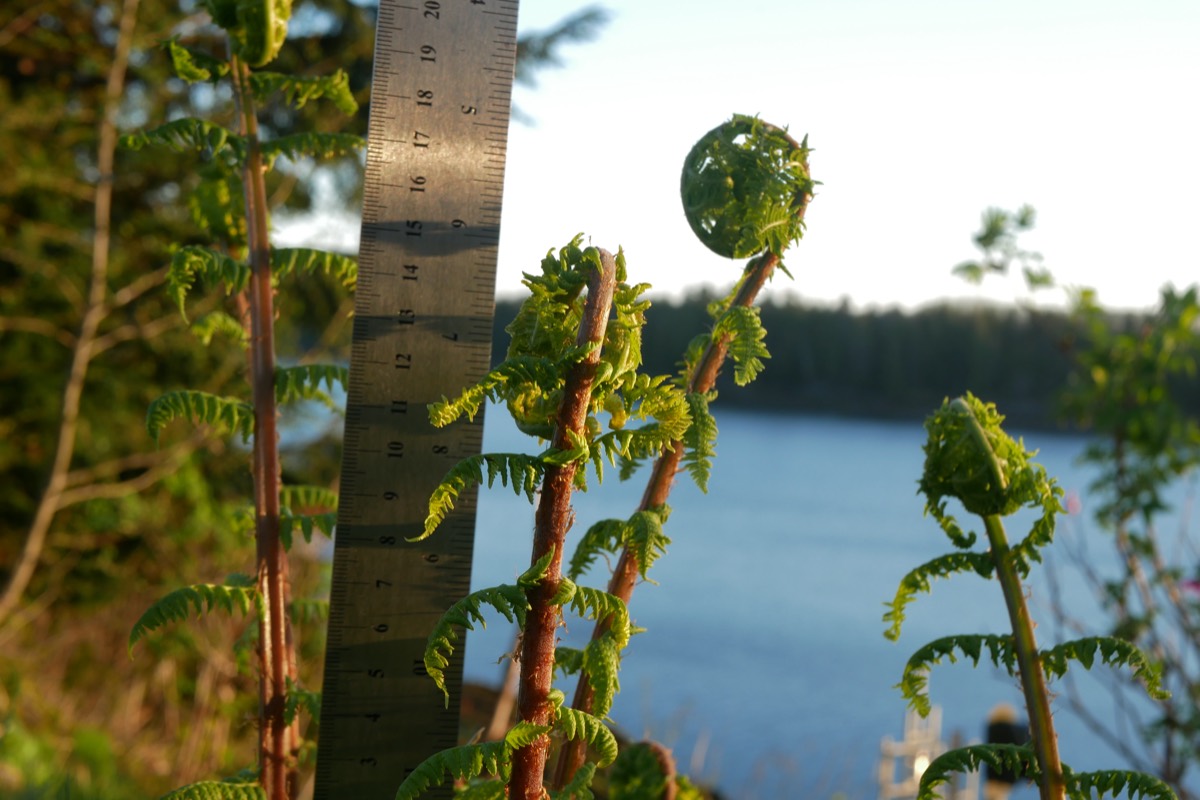
Photo by WindBorneListener · CC0 1.0
The other path is to wait
Dormant seeds in the soil are a second store. Flowering plants recovered from that seed bank after the ferns. Seeds that can wait did better than plants that had to sprout at once.
In North America, plants that already dropped their leaves and paused did better than evergreens that needed sun all year. A deciduous plant is built for a season with no photosynthesis. An impact winter is a harsh version of that season.
The ginkgo lineage lived through the boundary. A ginkgo tree drops its leaves and starts again in spring. It is a tree, not a typical houseplant, and it is one living reminder of that habit.
Bulbs, tubers, and rhizomes are the same idea in a pot. Food sits below the surface. The leaves can go. The store remains. A plant with nothing underground, and no seed waiting, has less to fall back on.
What this means for a plant at home
You cannot test a meteor on a windowsill. You can see the traits. A fern, a snake plant, or a ZZ plant can sit through a long dim stretch because it stores growth underground. A snake plant was not alive 66 million years ago. The rhizome is the shared idea, not a shared family tree.
A monstera or a fiddle-leaf fig grows whenever it has light. A dark week is fine. Months without useful sun are not. Those plants are strong houseplants. They are weak impact-winter plants.
Match the room you have, not a disaster film. Ferns still want moisture and indirect light. A tough rhizome plant still rots if the pot stays wet. How much light houseplants need and beginner indoor plant care cover the room you actually live in.
If you want the name of the fern on the shelf, plant identification and the the species database attach care notes to that species. Download Planti on iOS or Android when you want that card kept with the plant.